Looking beyond the diagnosis to support bathroom independence for autistic people.
Looking beyond the diagnosis to support bathroom independence in autism: Why bathroom participation deserves more attention
Walk into almost any bathroom and you’ll find the same familiar things: a toilet, a sink, soap, towels and a mirror. It’s a room most of us use several times a day without giving it a second thought.
As occupational therapists, we see something quite different.
We see one of the most complex occupations people perform every day, which has a profound impact on health, independence and quality of life.
Before someone even sits on the toilet, they need to recognise signals from their body, pause what they’re doing, move safely to the bathroom, manage clothing, maintain balance, complete personal hygiene, wash and dry their hands and then return to whatever they were doing before. Most people complete this sequence automatically. For many autistic individuals, it can require significant effort.
When we understand everything that happens behind what appears to be a simple routine, it becomes much easier to understand why bathroom participation can sometimes be challenging.
Looking beyond the bathroom, looking beyond the diagnosis
One of the things I love most about occupational therapy is that we’re naturally curious. We rarely stop at what is happening. Instead, we ask why.
If an individual with a diagnosis of autism isn’t yet independent in the bathroom, our first question isn’t, “How do we teach them to use the toilet?” Instead, we ask, “What is making this occupation difficult?”. That shift in thinking changes everything.
Rather than assuming the diagnosis explains the challenge, we begin exploring the interaction between the person, the occupation and the environment. This is the foundation of the Person-Environment-Occupation (PEO) model, a framework that reminds us that participation is rarely influenced by one factor alone. Instead, it is the relationship between all three that shapes occupational performance. This approach moves us away from trying to change the individual and towards understanding how we can better support participation.
We don’t begin with the diagnosis. We begin with the occupation
Looking beyond the bathroom: A bathroom is more demanding than it looks
Bathrooms are often one of the smallest rooms in the home, yet they ask an enormous amount of the people using them. Perhaps the question isn’t simply, “Why is this person finding the bathroom difficult?”, but rather we should also be asking, “Have we designed bathrooms that make participation unnecessarily difficult?”
Imagine trying to recognise that you need the toilet, stop an activity you are enjoying, transition to another room, tolerate bright lights or unexpected noises, remember the sequence of the routine, manage your clothing, maintain balance, complete personal hygiene and return to what you were doing.
That’s a lot for any nervous system to coordinate.
Research increasingly reflects what many occupational therapists observe in practice every day. Independence with personal care is rarely influenced by one isolated factor. Instead, it depends on the interaction between sensory processing, executive functioning, motor planning and the demands of the environment.
For individuals with autism, differences in interoception may also make it difficult to recognise the body’s signals, while sensory processing differences can make bathrooms feel overwhelming. Bright lighting, echoing acoustics, extractor fans, automatic hand dryers, unfamiliar smells and changes in routine can all increase cognitive and sensory load. None of these experiences happen in isolation. They interact, influencing how someone experiences the occupation as a whole.
Thinking like an occupational therapist
Occupational therapists are trained to look beyond the obvious. Rather than focusing solely on the person, we also analyse the occupation itself. Bathroom participation is not one task. It is a sequence of occupations.
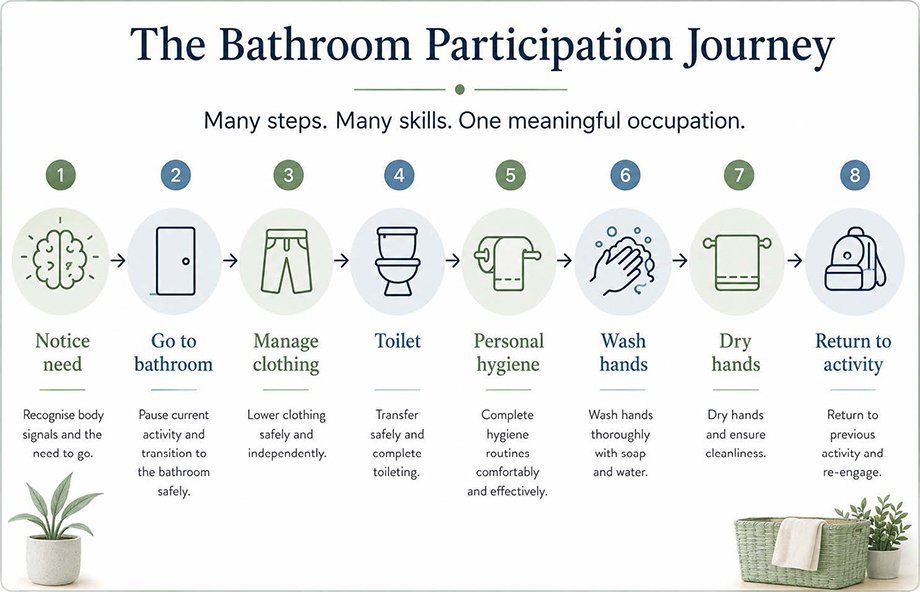
Each stage places different physical, sensory, cognitive and emotional demands on the individual. By breaking the occupation down into manageable parts, we can begin to identify exactly where participation becomes difficult and where support is most likely to make a difference. This approach allows interventions to be targeted, meaningful and genuinely person-centred.
The environment is part of the intervention
As occupational therapists, we often say we shouldn’t expect people to adapt to environments that don’t meet their needs. Instead, we ask how the environment can better support occupational performance.
Simple adjustments can make a significant difference, such as:
- Reducing unnecessary noise.
- Creating predictable routines.
- Using visual supports.
- Improving lighting.
- Reducing clutter.
- Keeping frequently used items in consistent locations.
These changes don’t alter who the person is. They reduce unnecessary barriers, allowing strengths to emerge and participation to increase.
Sometimes the most effective intervention isn’t teaching a new skill. It’s changing the environment so that the occupation becomes easier to complete.
When environmental adaptations aren’t enough
There are times when changes to the environment alone don’t provide the level of support someone needs.
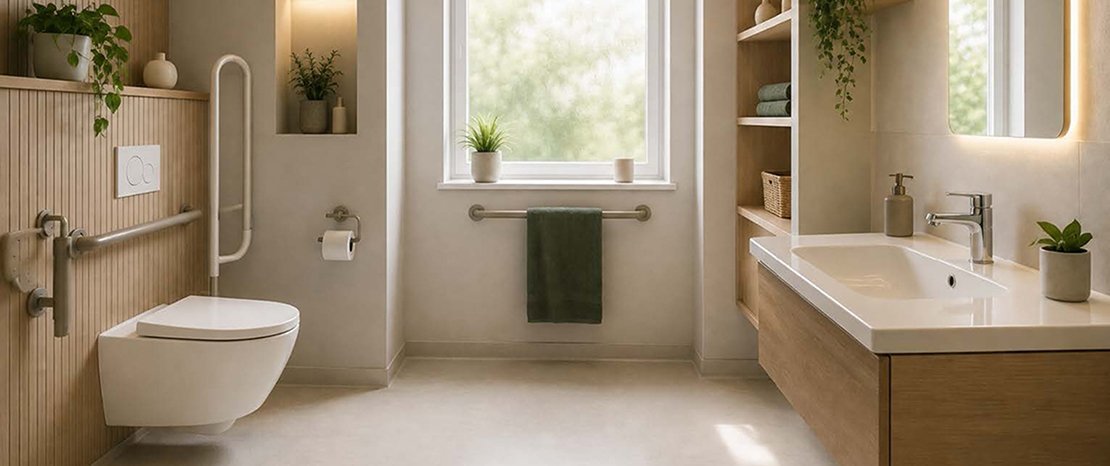
Following a comprehensive occupational therapy assessment, specialist equipment may form part of a wider intervention plan. Environmental adaptations and assistive technology can help reduce physical effort, improve hygiene, increase independence and support dignity.
Importantly, equipment should never be viewed as the starting point or the complete solution. It is most effective when recommended as part of a holistic assessment that considers the person’s goals, the demands of the occupation and the environment in which it takes place.
Looking beyond the bathroom
Bathroom participation is about far more than using the toilet.
It’s about being able to:
- Stay at a friend’s house.
- Feeling confident enough to go on a school trip.
- Travelling without anxiety.
- Reducing reliance on family members.
- Maintaining privacy.
- Protecting dignity.
- Participating in everyday life.
As occupational therapists, we have the privilege of looking beyond a diagnosis to understand the person, the occupations that matter to them, and the environments in which those occupations take place. With that comes a responsibility to advocate for environments that enable participation, rather than create unnecessary barriers.
Sometimes the smallest room in the house can have the greatest impact on independence, dignity and quality of life. Bathroom participation is about far more than toileting. It is about confidence, autonomy, privacy and the opportunity to participate in everyday life with dignity. By changing the environment, rather than expecting the individual to adapt to it, we don’t just improve a bathroom routine, we create opportunities for meaningful participation, greater independence and a better quality of life.
Perhaps it’s time we started talking about bathrooms a little more..
References
- Gan, H., Su, Y., Zhang, L., Huang, G., Lai, C., Lv, Y. and Li, Y. (2023) ‘Questionnaire-based analysis of autism spectrum disorders and gastrointestinal symptoms in children and adolescents: a systematic review and meta-analysis’, Frontiers in Pediatrics, 11, 1120728. Available at: https://doi.org/10.3389/fped.2023.1120728
- Law, M., Cooper, B., Strong, S., Stewart, D., Rigby, P. and Letts, L. (1996) ‘The Person–Environment–Occupation Model: A transactive approach to occupational performance’, Canadian Journal of Occupational Therapy, 63(1), pp. 9–23.
- MacAlister, L. (2024) Toileting and autistic children. National Autistic Society.
- Stacey, N., Turtle, B. and Daly-Lynn, J. (2026) ‘An Investigation of Factors Affecting Bowel Movement Hygiene in Autistic Children’, Occupational Therapy International, 2026, Article 5464138. Available at: https://doi.org/10.1155/oti/5464138
- Tazinaffo, L.S., Wolf, B.B. and Sposito, A.M.P. (2026) ‘Performance of Daily Living Activities of Autistic Children With Sensory Processing Difficulties: Caregivers’ Perceptions’, Occupational Therapy International, 2026, e5556699. Available at: https://doi.org/10.1155/oti/5556699