Paediatric Solutions

The Rifton Rollover

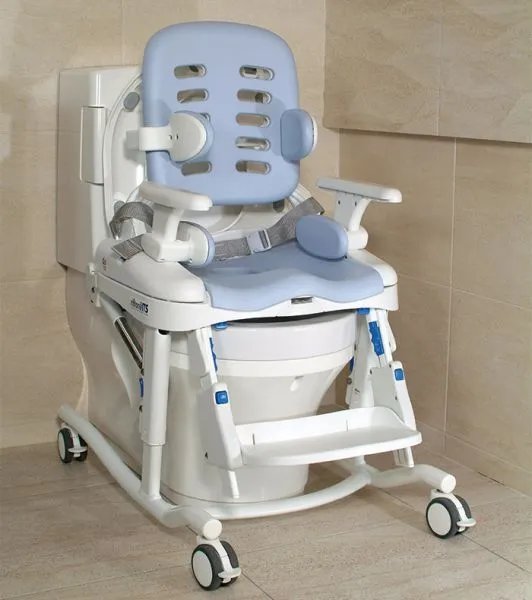
It provides a robust ’tilt-in-space’ shower/commode chair, capable of serving a child and their carer for many years. A raft of accessories enables personalisation to each child’s needs.

  • Medium and large sizes
  • Secure fittings from ‘head to toe’
  • Range of accessories for optimum tailoring to individual requirements
  • Compatible with Closomat Palma Vita (single extended douche)
  • Safe working load: 68Kg/10.7St
Rifton HTS shower and commode chair positioned over a wash and dry toilet

What do you do when a child cannot sit safely on the toilet in the first place?

If a child cannot maintain safe or functional positioning during toileting, Rifton HTS provides structured postural support to enable safe participation. It stabilises alignment, reduces risk, supports hygiene, and creates a pathway towards independence when combined with appropriate toileting systems.

When does toileting break down in paediatric cases?

Can the child sit safely and maintain a stable posture throughout the toileting task?

ASK

If not, you will often see:

  • Loss of balance or midline control
  • Sliding, leaning, or collapse during sitting
  • Inconsistent or unsafe positioning for hygiene
  • High reliance on carers to stabilise or reposition
  • Reduced tolerance for toileting routines

At this stage, the issue is not the toilet itself.

It is the child's ability to safely participate in the task at all.

Why is postural stability the starting point?

This affects:

  • Hygiene effectiveness
  • Safety during sitting
  • Confidence and routine development
  • Carer involvement and physical demand

How do we support toileting?

The question shifts from:

How do we create a safe, functional position that makes toileting possible?

To:

What changes when you introduce Rifton HTS?

Instead of adapting around instability, it addresses it directly by:

  • Supporting midline alignment
  • Maintaining pelvic positioning
  • Providing controlled, secure seating

This enables:

  • Safe participation in toileting
  • Consistent positioning for hygiene
  • Reduced need for constant carer intervention

It acts as a bridge between full assistance and developing independence.

What outcomes should you expect?

Rifton HTS supports:

  • Improved postural stability and alignment
  • Reduced risk of falls or positioning-related injury
  • Safer and more controlled toileting routines
  • More effective hygiene through correct positioning
  • Reduced physical strain on carers

Importantly, it also supports:

  • Routine formation
  • Confidence in toileting
  • Gradual development of independence over time

How does Rifton HTS enable safe participation?

It works by:

  • Securing the child in an aligned, supported position
  • Reducing the need for active balance control
  • Allowing focus on the task rather than maintaining posture

This transforms toileting from an unsafe or inconsistent activity into one that is structured and repeatable.

What if hygiene is also compromised?

Even with support, can the child complete hygiene independently?

Ask

If the answer is no, integration becomes key.

How does Rifton HTS work with wash and dry systems?

This allows you to move from:

1

Supported positioning

2

Stable seating

3

Automated hygiene

The combined system:

  • Positions the child correctly for effective washing and drying
  • Removes the need for manual wiping
  • Reduces repositioning and handling

The result is:

  • More consistent hygiene
  • Reduced carer involvement
  • A clearer pathway towards independence

Which children benefit most from Rifton HTS?

Common presentations include:

  • Cerebral palsy
  • Global developmental delay
  • Neuromuscular conditions
  • Low tone or reduced trunk control
  • Postural instability or asymmetry
  • Complex physical disabilities

In each case, the shared issue is not motivation or routine.

It is physical stability within the task.

How should you approach assessment?

Focus on:

Postural alignment

  • Can the child maintain midline position?
  • Is pelvic stability achievable without support?

Safety

  • Is there a risk of sliding, leaning, or collapse?
  • What level of supervision is required?

Hygiene capability

  • Does positioning allow effective cleaning?
  • Would integrated wash and dry improve outcomes?

Development and progression

  • Is the goal immediate safety or long-term independence?
  • Will the system adapt as the child grows?

Carer impact

  • How much handling is currently required?
  • Can lifting, repositioning, or hygiene support be reduced?

Where does Rifton HTS sit in the toileting pathway?

1

Child cannot sit safely on a standard WC

2

Rifton HTS

1

Hygiene cannot be managed independently

2

Palma Vita + HTS

1

Independence developing over time

2

Adjustable HTS configuration

It enables participation first, with independence developing progressively.

Why specify Rifton HTS?

It allows you to:

  • Enable safe toileting from the outset
  • Provide correct positioning for hygiene and comfort
  • Reduce carer strain in complex cases
  • Integrate with wash and dry systems for full task completion
  • Adapt the solution as the child develops

This makes it both a functional and developmental intervention.

Smiling young girl holding a toothbrush in a bathroom

What should you do next?

Identify postural needs, define positioning requirements, and determine whether integration with wash and dry technology will support independence.